


YPM 2.1 - Man Overboard
First airtime BBC: 3 December 1987
Length: 30 minutes
| Cast | Crew | |
|
Details Will be added soon.. |
Details Will be added soon.. |
 Plot: Sir Humphrey has a meeting with Sir Alan, Permanent Secretary of the Ministry of Defence (MOD), and General Howard, Chief of Defence Staff. All of them are worried about the Employment Secretary's plan to move a large portion of the Defence to the north of England and Scotland, so to reduce unemployment in the north. MOD and the Defence Staff are not happy with the plan, because it will mean that officers will have to live far away from Harrods, Wimbledon, Ascot, etc. Sir Humphrey suggests that instead of these "strategic" arguments, they probably should play on the man instead of the ball. They agree that the best strategy is to let Jim Hacker become paranoid about the ambitions of the Employment Secretary.
At the Cabinet Committee meeting nearly everyone is in favour of the Employment Secretary's plan, including Jim Hacker. Only the Minister of Defence is not in favour. Dudley, the Employment Secretary, asks the PM to have 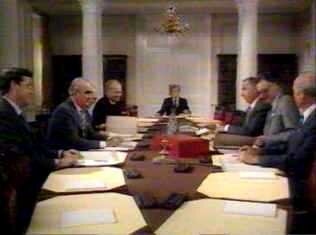 this status reflect in the minutes of the meeting. After the meeting Sir Humphrey praises the Employment Secretary. He also suggests that the Employment Secretary is very popular and that there is even talk of him being the next Prime Minister. Jim Hacker is shocked; why is there talk of his possible successor? Sir Humphrey suggests to Jim to check with the Chief Whip about this.
After Sir Humphrey leaves, Bernard goes after him to talk about the the Employment Secretary plotting against the PM. Sir Humphrey is very surprised that there is a plot. Now Bernard suddenly realizes that there isn't actually any evidence of a plot. Sir Humphrey explains to him that the Chief Whip is bound to be vague regarding any suspicion of a plot, to protect his position in case the plot later on turns out to be real. Sir Humphrey instructs Bernard to keep him informed about everything.
As Sir Humphrey predicted, the Chief Whip kept very  vague about a possible plot against Jim Hacker. He tells Jim he hasn't got any evidence against Dudley, but always his suspicions. He promises Jim to further look into this and check with the other Whips.
Lunching with Sir Arnold, Sir Humphrey tells him about the Employment Secretary's plan of relocating most of the Defence to the north. He asks Arnold to leak some disinformation to the press. Since it is only confidential disinformation - and not confidential information - Sir Arnold is happy to oblige.
Next day, the papers have the story that the Employment Secretary's plan has been blocked by Jim Hacker. Jim sees this as the ultimate proof that the Employment Secretary is plotting against him. He feels he cannot go ahead with Employment Secretary's plan anymore. Sir Humphrey shows him an MOD document that lists all the strategic arguments against the plan. Implicitly, Jim suggests that the public should know about these arguments (thus asking for a press leak).
 Next day, before the Cabinet Committee meeting Jim discusses the situation with Sir Humphrey. Jim does not want to loose the Employment Secretary but also does not want this row to go on publicly any further. Sir Humphrey suggests a three-point plan: 1) that everyone agrees to Cabinet's collective decision; 2) that there be a cooling-off period; 3) that every press release and speech first be cleared with the Cabinet Office. Jim Hacker agrees with this plan.
At the Cabinet Committee meeting the Employment Secretary asks why his plan is not on the agenda. Jim explained that he wants to postpone discussion to a later date. The Employment Secretary is baffled by this since everyone, except the Minister of Defence, was in favour. Jim Hacker denies that he was in favour, and he is backed by Sir Humphrey who points out that the minutes of the last meeting do not show the PM embracing the plan. Then Jim puts forth the three-point plan. The Employment Secretary however will not accept the last point: clearing everything with the Cabinet Office. Jim Hacker can then only suggests that the Employment Secretary has to consider his position.
 Later on, Bernard informs Jim that the Employment Secretary has indeed resigned and accuses Jim of a dictatorial style of government. Jim is not pleased with his resignation, although he is pleased that he is called dictatorial. Sir Humphrey tells Jim that he understood the Employment Secretary was going to resign anyway on Budget Day on the grounds that he expected insufficient budget to fight unemployment. In a private chat between Bernard and Sir Humphrey it turns out that Sir Humphrey understood this to be true, but he may have misunderstood.
Next, Jim Hacker has a brilliant plan: with the Employment Secretary out of the way, Jim can now reinstate the plan. This will make it look like the Employment Secretary's resignation was pointless. Sir Humphrey is shocked by this unexpected turn, but he can do nothing but to agree to put it on the agenda of the next Cabinet Committee.
Rating (0-10): 8
Top 5 Quotes
 Sir Humphrey: "It is characteristic of all committee discussions and decisions that every member has a vivid recollection of them and that every member's recollection of them differs violently from every other member's recollection. Consequently, we accept the convention that the official decisions are those and only those which have been officially recorded in the minutes by the Officials, from which it emerges with an elegant inevitability that any decision which has been officially reached will have been officially recorded in the minutes by the Officials and any decision which is not recorded in the minutes is not been officially reached even if one or more members believe they can recollect it, so in this particular case, if the decision had been officially reached it would have been officially recorded in the minutes by the Officials. And it isn't so it wasn't."
- Sir Humphrey: "Now go in there and inform me of their conversation."
Bernard Woolley: "I'm not sure I can do that, Sir Humphrey. It might be confidential."
Sir Humphrey: "Bernard, the matter at issue is the defence of the realm and the stability of the government."
Bernard Woolley: "But you only need to know things on a need to know basis."
Sir Humphrey: "I need to know everything! How else can I judge whether or not I need to know it?"
Bernard Woolley: "So that means you need to know things even when you don't need to know. You need to know them not because you need to know them, but because you need to know whether or not you need to know. And if you don't need to know you still need to know, so that you know there is no need to know." - Sir Arnold: "I presume the Prime Minister is in favour of this scheme because it will reduce unemployment?"
Sir Humphrey: "Well, it looks as if he's reducing unemployment."
Sir Arnold: "Or looks as if he's trying to reduce unemployment."
Sir Humphrey: "While as in reality he's only trying to look as if he's trying to reduce unemployment."
Sir Arnold: "Yes, because he's worried that it does not look as if he's trying to look as if he's trying to reduce unemployment." - Sir Arnold: "Are you suggesting that I give confidential information to the press?"
Sir Humphrey: "Certainly not, Arnold. This is confidential disinformation."
Sir Arnold: "Ah, that is different." - Sir Humphrey: "Why do they want your job [PM] so much?"
Jim Hacker: "Because I am the only member of the government that can't be send to Northern Ireland next week."
YPM 2.2 - Official Secrets
First airtime BBC: 10 December 1987
Length: 30 minutes
| Cast | Crew | |
|
Details Will be added soon.. |
Details Will be added soon.. |
 Plot: Together with the Solicitor-General and a number of officials, Jim Hacker discusses the clearance of chapter eight of his predecessor's memoirs. Jim has a problem with this chapter, which is entitled "The two faces of Jim Hacker". The Solicitor-General however stresses that there are no grounds for refusing publication, since security is not at stake. Jim Hacker however feels that lies like that should not be published and he orders the Solicitor-General not to grant permission for doing so.
The next day, chapter eight has been leaked to the press, along with the story that Jim Hacker tried to suppress it. Jim is furious and demands to find the culprit. Sir Humphrey wants to rush off to set up a leak inquiry but he is stopped: Jim wants to find out who really leaked it. Bill Pritchard, Jim's Press Officer, wants a press statement from Jim regarding the leak. Jim is disappointed that now the press wants a statement, while in  the previous week the press ignored his news about détente with the Soviets. Jim orders him to tell the press everything is a pack of lies, including the story that he tried to prevent publication. Furthermore, he orders him to smear his predecessor and imply he has lost his senses. Bill rushes off to tell this, in more diplomatic terms, to the press.
Next, Jim demands Sir Humphrey to ensure the culprit is found and convicted for the leak. Sir Humphrey points out that under the present political system they can prosecute, but not be sure of a conviction. Jim suggests to lean on the judge to guarantee success. Sir Humphrey suggests it is better to find a judge that doesn't need to be leaned on.
Next day, Jim Hacker has lunch with Derek Burnham, the Editor of the Daily Post who published the leak. Jim argues that the whole story is untrue and that the Daily Post should retract it. Derek is willing to do that if he has some hard evidence that Jim Hacker didn't try to prevent publication. Jim Hacker promises Derek to give him the minutes of the meeting. Bernard, who is also present, is shocked by this promise.
 Bernard goes to see Sir Humphrey about it. He explains to Sir Humphrey that the minutes aren't written yet and asks him what to do. Sir Humphrey advice: write them. Bernard asks whether this means that he should falsify the minutes by writing that Jim did not oppose publication. Sir Humphrey wants nothing of that sort. He explains to Bernard that writing minutes is choosing between different elements from a wide ranged discussion. The minutes should reflect what the PM wanted to say, not what he actually said. And during the discussion the PM did accept the fact that there where no legal grounds for withholding publication. Now Bernard understands how to write the minutes.
After the minutes are published, Bernard is harassed by a bunch of reporters outside Number Ten. They all ask him questions why the minutes were published if they fall under the Official Secrets Act. Bernard's replies suggest that the Prime Minister thinks he is above the law. Bernard immediately goes to see Jim about his little talk with the press. Jim Hacker 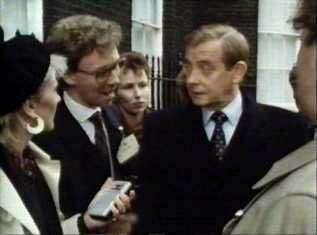 explodes! After a lifetime of avoiding answering questions in the Civil Service, Bernard suddenly is answering questions of the press! Jim calls in Sir Humphrey and Bill Pritchard. He asks Sir Humphrey why de culprit of the leak has not been found yet. Sir Humphrey now realises that the PM really wants to find the culprit, so he calls in the Special Branch.
Regarding the relationship with the press they suggest that instead of trying to appease them, the best strategy is probably to give them a story. Sir Humphrey suggests to expel seventy-six Soviet diplomats, since this always worked in the past. Jim Hacker is not convinced this will work.
The Special Branch investigation quickly reveals that the Press Officer of the Department of Energy was the one that leaked the story. The reason was that chapter eight described the Energy Secretary as the ablest Minister in Cabinet. Jim wants to prosecute the Press Officer. Sir Humphrey however points out that the Special Branch then first should investigate the earlier leak of chapter 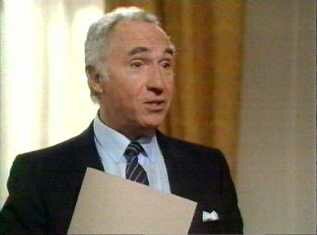 five, which praised Jim Hacker for his efforts in Qumran. Jim therefore orders Sir Humphrey to fire the Press Officer. But Sir Humphrey points out that the Press Officer will then probably sue the government for wrongful dismissal, on the grounds that he was carrying out an implied instruction from his Minister. The only one Jim can fire is the Energy Secretary, as he is responsible for his department. Since Jim already lost a Minister the week before, he doesn't want to do that.
Sir Humphrey presents Jim with a press statement that blames the whole thing on miscommunication. And Sir Humphrey reports there is very worrying news from the Foreign Office, regarding espionage at the Soviet Embassy. Jim acts immediately and orders to expel them, all seventy-six!
Rating (0-10): 6
Top 5 Quotes
- Bernard Woolley: "Well, thinking back on what I said, and what they said, and what I said you said, and what they may say I said you said, or what they may have thought I said I thought you thought, well, they may say I said I thought you said you thought..."
Jim Hacker: "Go on, Bernard."
Bernard Woolley: "Well, I think I said you said you thought ... you were above the law."
Jim Hacker: "YOU SAID THAT?!"
Bernard Woolley: "Well, not intentionally. It is just the way it came out. I am terribly sorry but they were asking me all these questions."
Jim Hacker: "Bernard, just because people ask you questions, what makes you think you have to answer them?"
Bernard Woolley: "Well, I don't know."
Jim Hacker: "You never answered my questions just because I ask them." - Sir Humphrey: "It's up to you, Bernard, what do you want?"
Bernard Woolley: "I want to have a clear conscience."
Sir Humphrey: "A clear conscience."
Bernard Woolley: "Yes"
Sir Humphrey: "When did you acquire this taste for luxuries?" - Sir Humphrey: "The purpose of minutes is not to record events, it is to protect people."
- Jim Hacker: "Now about nailing that leak..."
Bernard Woolley: "I'm sorry to be pedantic, but if you nail a leak you make another." - Jim Hacker: "I want this traced at once. It must have been someone at yesterday's meeting."
Sir Humphrey: "Well, I'll set up a leak inquiry straight away."
Jim Hacker: "I don't want a leak inquiry. I want to find out who did it."
YPM 2.3 - A Diplomatic Incident
First airtime BBC: 17 December 1987
Length: 30 minutes
| Cast | Crew | |
|
Details Will be added soon.. |
Details Will be added soon.. |
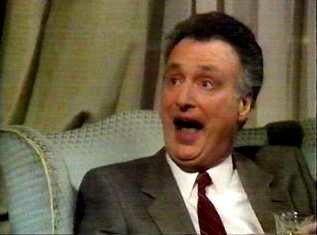 Plot: Jim Hacker is anxious to finalize the negotiations with the French over the Channel Tunnel. He proposes to have a summit meeting with the French President to solve the outstanding issues. Sir Humphrey quickly demonstrates the complexity of the outstanding issues, that all have to do with sovereignty between Britain and France. Jim Hacker soon realizes that the Foreign Office is better equipped than he is to solve these.
Then Sir Humphrey turns to the issue of Jim's predecessor's memoirs. The former PM has requested access to some government papers. Jim doesn't want to give him access, as he is still angry that he described Jim Hacker as two-faced. Then they receive the news that the former PM has just died of a heart attack. Jim has trouble hiding his joy about this news. Such a tragic loss, since now his memoirs cannot be finished! Jim agrees that the former PM should have a state funeral.
The arrangements for the funeral are going splendid; a large number of world leaders have accepted the invitation. The funeral also provides good opportunity for Jim to be shown on television among the world leaders.
Then Bernard brings the news that instead of the French Premier the French President is coming to the funeral. And the French President plans to give the 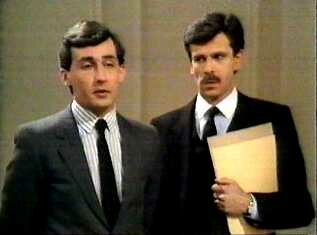 Queen a little puppy from the litter of the labrador that the Queen gave to the President on her state visit to France three years before. Because of the British quarantine laws, her Majesty however will have to refuse the gift. Jim Hacker suddenly realizes that the French are trying to create a diplomatic incident to gain advantage in the Channel Tunnel negotiations. He consults with the Home and the Foreign Office whether there is a way around this problem. However, they see none.
The French Ambassador comes over to see Jim. First, he proposes to solve the outstanding issues over the Channel Tunnel in a meeting with the French President during the funeral. Jim doesn't want to look to eager in finalizing the Channel Tunnel negotiations, so he only promises to talk, not to negotiate. Second, the Ambassador requests that the French police be in charge of the French President's security during the visit. Sir Humphrey explains that if all world leaders bring in their own police force, this doesn't make London into a safer place. Finally, the Ambassador brings the news of the gift the French President is  planning to give to the Queen. Jim Hacker explains the quarantine laws of Britain, but the Ambassador is most offended that the Queen would reject a gift similar to the one she gave to the French President. Jim Hacker urges the Ambassador to bring a different kind of gift, but the Ambassador states that the President's wife is determined on it.
The day before the funeral has arrived and the Civil Service still hasn't been able to solve the puppy crisis. They came up with all sorts of crazy ideas like making Buckingham Palace a dog quarantine zone, or making it part of the French Embassy. Bernard is making sure everything is arranged for the funeral. He is called in by Jim regarding the status of the puppy. The file on it already weights more than the puppy itself. The Foreign Office has informed the French that the puppy will be put into quarantine as soon as the dog arrives at Heathrow Airport. Then Sir Humphrey brings the news that the police have just found a bomb on the grounds of the French Embassy. Nobody knows who planted it there, but a good thing it was found. Furthermore, Sir Humphrey informs Jim that the French President is not flying in, but driving. Jim cannot risk having a diplomatic car searched looking for the dog.
 At the evening reception for the foreign guests, Jim is urged by Sir Humphrey to finally talk to the French President. On his way to see him, Bernard urgently brings Jim the news that the French police have planted the bomb on the Embassy terrain. They wanted to prove the British security was inefficient. Jim now sees a way to gain an advantage in the Channel Tunnel negotiations. He instructs Sir Humphrey to bring in the evidence after his talk with the French President has started.
At the talk with the French President the first issue is the puppy gift. The French President tells Jim the French people will view the rejection of the gift as an affront to France. Turning to the Channel Tunnel, he states that the French people cannot accept another slap in the face. Then Sir Humphrey brings in the evidence of the bomb planted by the French police. Jim acts like he is completely shocked by this, and states that if this becomes public, the British people will not want to make any concessions. The French President has no choice but to agree to the border in the middle of the Tunnel, half the signs in English and the starting ceremony in Dover. Jim Hacker has triumphed!
Rating (0-10): 9
Top 5 Quotes
- Bernard Woolley (on the phone): "No, we can't have alphabetical seating in the Abbey: you would have Iraq and Iran next to each other. Plus Israel and Jordan, all sitting in the same pew. We would be in danger of starting World War III."
- French Ambassador: "Prime Minister, I cannot tell you the gravity of the affront my Government would feel if Her Majesty were to refuse a gift in exchange for the one our President accepted from her. I feel it would be interpreted as both a national and a personal affront to the President and his wife."
Jim Hacker: "Excellency, you must ask the President not to bring that bitch with him. .... The puppy! I mean the puppy!" - Jim Hacker: "Plenty of room for television cameras, won't there?"
Sir Humphrey: "Yes."
Jim Hacker: "Outside Number Ten, along the route, outside the Abbey, inside the Abbey. One pointing directly at my pew."
Sir Humphrey: "Uhm...now wouldn't that mean putting the cameraman in the pulpit?"
Jim Hacker: "Will that be all right?"
Sir Humphrey: "Well, it won't leave a lot of room for the Arch Bishop."
Jim Hacker: "Well, so where will he preach from?"
Sir Humphrey: "I think he'll need to be in the pulpit."
Jim Hacker: "Where will my camera be?"
Sir Humphrey: "Well, there is always the High Altar, but I think the Arch Bishop may need that as well."
Jim Hacker: "Who does he think he is?"
Sir Humphrey: "Well, he probably thinks it is a religious ceremony. Nobody has told him it is a Party Political." - Bernard Woolley (on the phone): "Yes, we will want simultaneous translators. ... No, not when the PM meets the leaders of the English speaking nations. ... Yes, the English speaking nations can be said to include the United States. With a certain generosity of spirit."
- Jim Hacker: "Don't we ever get our own way with the French?"
Sir Humphrey: "Well, sometimes."
Jim Hacker: "When was the last time?"
Sir Humphrey: "Battle of Waterloo, 1815."
YPM 2.4 - A Conflict of Interest
First airtime BBC: 29 December 1987
Length: 30 minutes
| Cast | Crew | |
|
Details Will be added soon.. |
Details Will be added soon.. |
 Plot: Nine out of ten newspapers are saying that Jim Hacker coming to power as PM has only produced a lot of talk, but no actual results. Jim is worried about this criticism, also in the light of the upcoming Party Conference. So he decides he has to appoint someone. Furthermore, there is a rumour about another scandal in the City, the financial heart of Britain.
Sir Humphrey, lunching with Sir Desmond Glazebrook, asks whether there is any truth in the rumour of another City scandal. Sir Desmond has to confirm that a company called Phillips Berenson is going bust. He fears that any subsequent investigation by the Bank of England into Phillips Berenson will reveal that they were involved in tax fraud, embezzlement and other dubious financial transactions. And Sir Desmond's bank has lent 400 million pounds to Phillips Berenson. Sir Desmond feels that the only way to prevent the scandal from going public and for his bank to keep the 400 million pounds, is for the Bank of England to bail out Phillips Berenson. That however depends on who is to be the new Governor of the Bank of England. He is shocked when Sir  Humphrey tells him that the PM wants to appoint Alexander Jameson. With Jameson as Governor, the Bank of England will never agree to bail out Phillips Berenson.
In the meanwhile, Dorothy and Jim are preparing his speech at the Party Conference. They cannot find any good news for Jim to refer to in his speech. Jim decides that the only thing he can do is to announce Alexander Jameson as the new Governor of the Bank of England. He asks Bernard to ask Sir Humphrey to see him about this later on.
Bernard delivers this message. Sir Humphrey tells Bernard that he will change the PM's mind about appointing Alexander Jameson as Governor. In the meeting with Jim Hacker, Sir Humphrey first fully supports the appointment of Jameson, but then starts to exaggerate Jameson's qualities (such as his honesty) to make them vices. Sir Humphrey even hints at a scandal regarding Jameson.
Sir Frank Gordon hears about this and goes to see Sir Humphrey about it. The Treasury wants an honest and competent man as Governor, and Jameson is their candidate. Sir Humphrey however points out that appointing Jameson will in the  short run reveal a scandal, resulting in a plunge of the pound, stock market and confidence in the government. Sir Frank however sees this as Sir Humphrey's problem, not his. Then Sir Humphrey points out that the Treasury is responsible for supervising the Bank of England, and the Bank of England in turn is to supervise Phillips Berenson. So in case the scandal comes out, the Chancellor will probably has to blame his Treasury officials for incompetence. Now Sir Frank fully understands it is also his problem.
Dorothy has gotten hold of a secret auditors report on Phillips Berenson and Jim is shocked by its findings. It also reports that Sir Desmond's bank is involved. Dorothy therefore thinks that Sir Desmond himself wants to become Governor of the Bank of England, to prevent the scandal from getting out. In a meeting with Sir Desmond, it turns out that that is indeed the case. Sir Desmond doesn't support the appointment of Alexander Jameson.
 At the Party Conference, Jim Hacker still wants to appoint Jameson as it is the only good news he has come up with. Then Sir Humphrey brings in the Burandan High Commissioner. It turns out that the President of Buranda is also involved in the Phillips Berenson scandal and that if Jim is to appoint Jameson, Buranda will sell all of its British Government stock (causing a run on the pound) and move to expel Britain from the Commonwealth. After the High Commissioner has left, Jim is very angry with Sir Humphrey for putting him in this position. Sir Humphrey swears he has only Jim's interest in mind. As an alternative to announcing the appointment of Jameson as Governor in his speech, Sir Humphrey suggests to announce a cut in interest rates. This will not happen with Jameson as Governor, but if Jim appoints Sir Desmond as Governor the interest rates will be cut immediately. Jim finally decides to appoint Sir Desmond and to announce the cut in interest rates in his speech.
Rating (0-10): 7
Top 5 Quotes
- Jim Hacker: "Don't tell me about the press. I know exactly who reads the papers:
- The Daily Mirror is read by people who think they run the country;
- The Guardian is read by people who think they ought to run the country;
- The Times is read by people who actually do run the country;
- The Daily Mail is read by the wives of the people who run the country;
- The Financial Times is read by people who own the country;
- The Morning Star is read by people who think the country ought to be run by another country;
- And the Daily Telegraph is read by people who think it is."
Sir Humphrey: "Prime Minister, what about the people who read the Sun?"
Bernard Woolley: "Sun readers don't care who runs the country, as long as she's got big tits." - Sir Humphrey: "When you wish to suggest that somebody is perhaps not the ideal choice..."
Bernard Woolley: "...you rubbish them?"
Sir Humphrey: "No, the first stage is to express absolute support."
Bernard Woolley: "Why?"
Sir Humphrey: "Because you don't want to go on record as saying somebody is no good. You must be seen to be their friend. After all, it is necessary to get behind someone before you can stab them in the back." - Jim Hacker: "As you know, I have got to appoint a new Governor of the Bank of England. I'd welcome your views."
Sir Desmond: "Well, I certainly think you should appoint one." - Jim Hacker: "Why should you be adamant that I should allow another cover-up? What's in it for you?"
Sir Humphrey: "Nothing, Prime Minister. I assure you I have no private ulterior motive. I am trying to protect you from yourself. I mean, I am entirely on your side."
Dorothy Wainwright: "How can we believe that?"
Sir Humphrey: "Because this time it is true!" - Sir Humphrey: "Tax fiddles?"
Sir Desmond: "Well, they placed their own interpretation on Treasury regulations. Someone has to interpret them."
Sir Humphrey: "What about the Treasury's interpretation?"
Sir Desmond: "It didn't seem appropriate."

